Tuesday, 2 May 2017

Photo Shoot


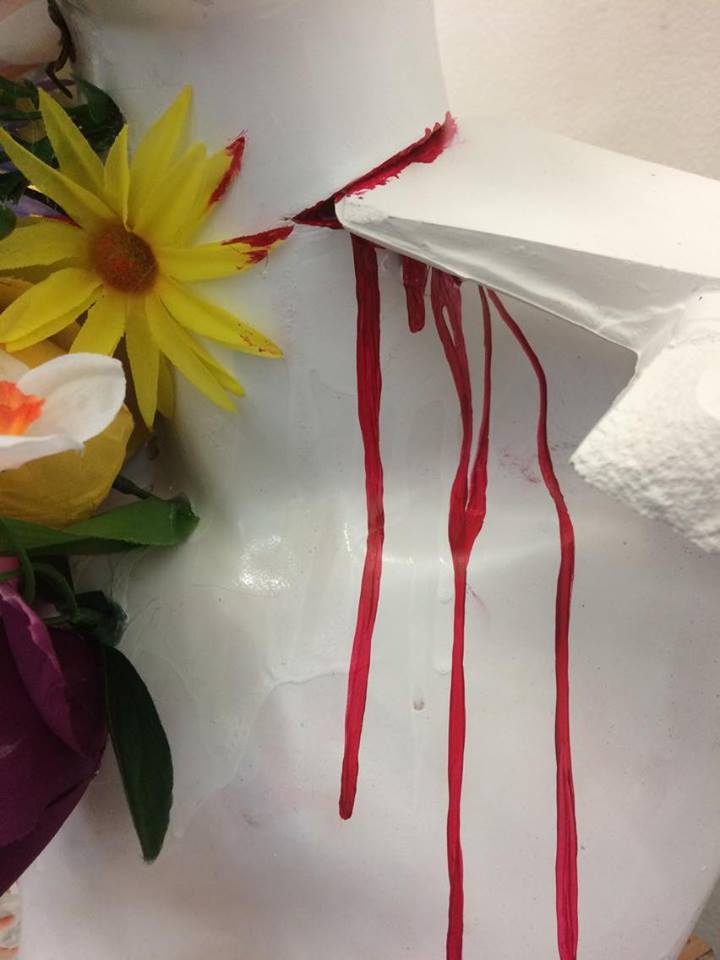
The blood on my mannequin unfortunately faded.
I wiped it off, and started over with acrylic paint.
I tried my best to mimic the natural flow of liquid.


 I feel that using acrylic paint was a much better idea in the end. It dried quickly, and the use of my small paintbrush also allowed me to add details above and around the axe blade, for extra depth.

I even dotted some "blood" onto the nearest flower, to very subtly merge the discord with the beauty of the piece.


Then, I began to experiment with lighting in a dark room.

I achieved a range of interesting images.

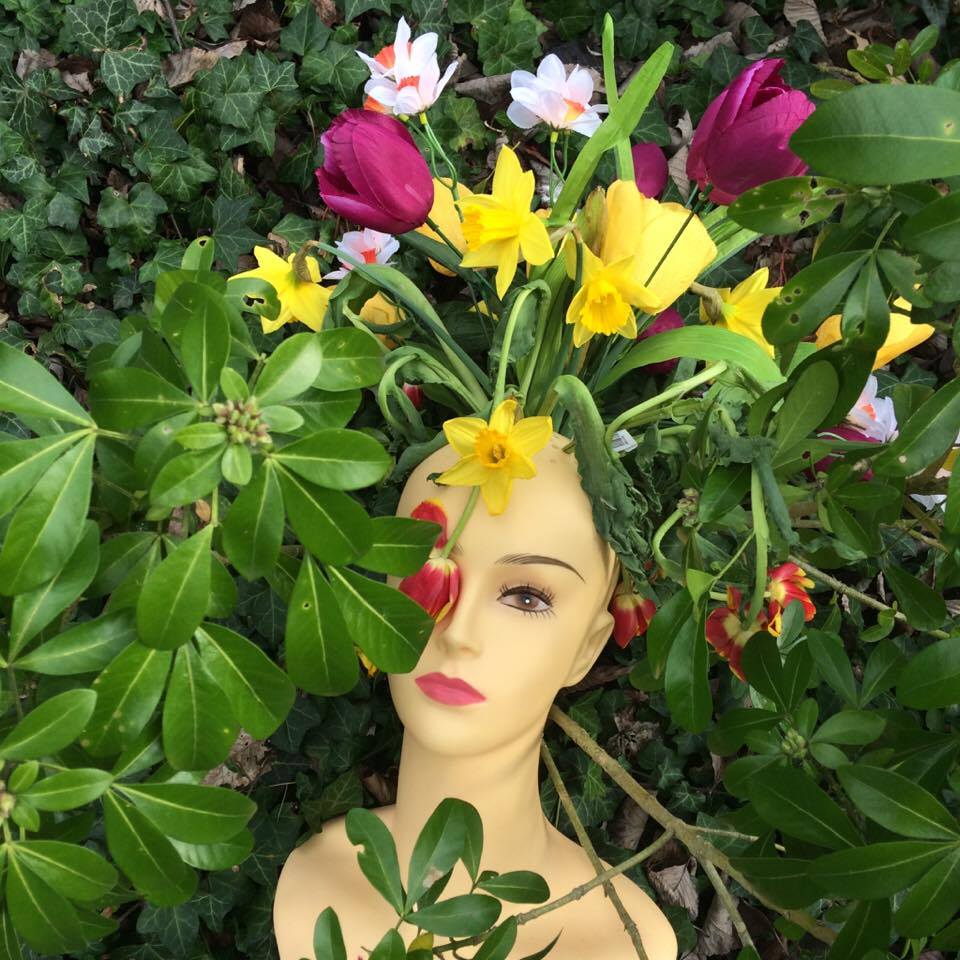
I focused on lighting the piece from the left hand side, to illuminate the colours of the flowers and cast interesting shadows from the foliage. I also enjoy the idea that the "happy" side of the piece is lit, whilst the "darker" side of the piece is quite literally darker.

This makes it even more difficult to notice the blood and the axe amongst the scattered lighting, further illuminating the metaphorical ignorance of man.


This image is especially interesting to me due to the single shadow cast across the mannequin's face. It reminds me of  Jess Riva Cooper's work, where she incorporates 3D flowers with 2D paintings, across and around the face. The 2D shadow could mimic a painted marking on the mannequin's face.


Some of these images are difficult to understand due to how close they are to the details of the mannequin, alongside the harsh lighting. I think that they create interesting, ambiguous pieces.


Whilst I was taking photos, I experimented briefly with a scarf.
I thought that wrapping a scarf around her "neck" would make her look slightly more human, by concealing her imaginary body.

The effect is interesting here. Draping the scarf over the axe made it look like she had a broad shoulder. Whilst the scarf is not ideal, and I could have done with a simpler, plain scarf, the idea was still there.


As a brief experiment, I draped the entire scarf over the top of the sculpture. This left a small, interesting window to the throat section of the sculpture, showing only some flowers and some blood. This created an incredibly ambiguous, incredibly difficult to understand photograph.


My favourite images of those that I have taken today are these:


Photography

Using Photography in my final outcomes: (key point)

Throughout the creation of my sculptures, I kept in mind how the audience would be viewing them. I thought about how to entice the viewer to travel around the sculpture, and how to distort/control their view. Although, there is only so much that I can control when a person can physically approach and view (even touch) a sculpture.

There are many imperfections in my sculptures that I cannot control or remove. I fear that they may ruin the effect of the sculpture.

For example:

^
What I wanted the audience to see
(vibrant, freshly "spilled" blood)


^
What they would actually see,
after the blood has dried/reacted over time.
v

From underneath, you can see that the blood has dried, and you can see the mess of hot glue that is keeping the axe in place.

This ruins the effect of the "floating" axe in her neck, and the realism of dripping blood.


Photography, on the other hand, allows me to completely 100% control what the viewer is seeing.

Images like this one*

*allow me to fully control what the user is seeing, from the correct angle, in the correct lighting, etc etc. The blood appears fresh and realistic, and you cannot travel behind the sculpture to see its imperfections.

Photography would be interesting to incorporate into my work, due to the fact that I can photo edit to my hearts desire to create a piece even more surreal than they are currently, if I wanted to.

Although, I don't think I would go down that route, as I have worked hard to construct this piece to be naturally, physically surreal to the naked eye.

I enjoy the idea that photography leaves many questions, as photographs are "proof" of something's existence, but can also be edited to create something that isn't real at all. I think that this sculpture makes it incredibly difficult to tell whether it is real, or whether it has been photo edited. It creates an ambiguous piece.


Anne Hardy:
I could relate this idea briefly to the work of Anne Hardy, who constructs entire rooms as sculptures, but only displays the photographs. They are surreal pieces that provoke questions as to whether it is real or not, as the room itself was never open in the flesh. No visitors allowed, only displays of photographs from the room.


These rooms are very surreal, and often disorganised, like a chaotic series of paintings. You can imagine that the experience of entering the room would be incredibly different to viewing the image. But the image allows you to see all that the artist wanted you to see, and you can still create your own interpretation of the effect of the room.

I find it interesting how the rooms were never open to the public, so it could have been argued that they never existed, if they weren't immortalised in photography.

I am interested in the idea that cameras never lie (although, photographs can be edited).


I'd like to have a series of images to display my sculptures in the way that I intended them to be, alongside the physical outcomes. 


Such as these images above, which were all temporary moments, that I have now captured.


I also like the idea of using photography, because I can crop them to certain size and hide the fact that it is just a head/just a face.

Originally, I would have liked to work on an entire lifesize, full-body mannequin. Unfortunately I did not have the means to do this, so stuck to the attainable bust mannequins. Photography allows me to construct the small heads in different ways that make them appear large and powerful.


I plan to experiment with lighting and composition in order to create a series of interesting photographs.

Sunday, 9 April 2017

Gaia Plantpot Continued


This is one of my final sculptures for this module. She has been explained in a previous blog post.

You may have thought that that was my final blog post about her, but due to the nature of her materials being ALIVE, there is much more to write about. Specifically the fact that the plant that is living in the head needs to be taken care of, and slowly dies if you don't.

I occasionally remove the wig to water the plant.


But occasionally, I do not water it at all.
My original plan was to let it die and monitor the process. You can see that in this image, the colour of the leaves has depleted. They are much less saturated, much weaker, and are becoming brown very slowly.

This broke my heart! I couldn't do it.
At the risk of forsaking my art project, I refused to let the plant die if I could help it stay alive.
This plant is alive, and its life has been placed in my hands.

No part of me would forgive myself if I consciously allowed this plant to suffer and die.

I began watering the plant again, and soon, the leaves became green and luscious.
Which was very odd, because they did not start off green, they started off pink.
I found this very interesting.


I started thinking about how Mother Nature is being displayed, here. She is a severed head. Although it is metaphorical, it is not very practical. It would make much more sense if she was attached to a body. Unfortunately I did not have the ability to create an entire lifesize sculpture, nor the funds to buy a full size mannequin.

I started wondering how to display her, to hide the bottom of her neck, and make it seem like she was peeking out of something much deeper. (... e.g, water).

I was immediately drawn to the idea of submerging her imaginary body in water. This is not only natural, and attainable, but it could work as an even greater metaphor.
Global warming is a real threat to nature, and if we imagine that this sculpture is a personification of 3017, it could be a very real possibility that water levels had risen by then.

I experimented with a photo editing application, to see how this would work.
v


I think the effects are very interesting, and very surrealist.
Although, I am not sure how I would implement it into a real physical sculpture. I do not possess a tank large enough to fill with water to replicate this idea, nor a safe way to suspend the head in it. Also, I think that it would drown the plant, if I was to place it in a body of water.

Photography:

It was at this point that I considered using a series of photographs as my final pieces, rather than actual sculptures. My sculptures are hard to control, as they involve life, light or temporary substances (fake blood).
See the next post for further explanation on this.


Assembly & Blood

Using this image as reference, I began attaching my artificial flowers permanently to the holes in my mannequin's head.

I used a hot glue gun to meticulously add flower after flower.

The fast drying nature of the glue made it easy to attach the flowers just as I wanted them, how I wanted to, where I wanted to. All I had to do was hold them in place for a few moments for the hot glue to set.

This was the result once I had added all of my flowers.
I am pleased with the outcome. I used many more flowers than I have done before, as the glue allowed me to do so without knocking any of the others away.

I enjoy the effect of compiling many different kinds of flowers, as it gives me a vast range of colours. It also works metaphorically, as this woman is an embodiment of Mother Nature, and Mother Nature does not discriminate between her children. They can all coexist harmoniously (in nature, or on her head!)

Left side view: The axe is completely concealed from this angle.


As lovely as this is, I almost felt that it was too lovely (even with the axe).
I had long been toying with the idea of adding fake blood to the axe, but was not sure if it would be "too much" or "cliche" to do so.

Now that I have reached this point, I decided that I definitely want to add fake blood. I feel that it would add to the piece, rather than take away from it.

I intentionally constructed my flowers in a way that there were many poppies, scattered across the head in order to create a good, balanced spread of red across the piece, just in case I did want to add blood later on. 


I ordered some fake blood from eBay. I've had experience with a lot of fake blood, so I was expecting  the blood I ordered to be a cold tone red, that would dry to a dark red/brown. Like real blood.
What I actually received was a very warm tone, almost pink tone red, which did not dry differently at all. When diluted, or used on the skin, it left a dreadful neon pink stain behind. This was the total opposite of what I wanted.

I decided to add it anyway, after much contemplation. It was an incredibly vibrant red, and I thought that this would compliment the red flowers very well, in the long run.

I bit the bullet and went for it.

I placed the nozzle of the fake blood tube directly beneath the blade and squeezed. I did not direct the blood, I just allowed it to drip naturally down the curvature of the mannequin.

I added more very slowly.
The drips appeared very natural, and very fresh. Surprisingly, the fake blood appeared much better on the white surface than it did on human skin. It looks much more realistic once applied. I'm glad I took the risk and went for it.

Here is a short video of the application of the blood. It's interesting to watch how it drips naturally with gravity.


The drips began to pool at the base of the mannequin. It was at this point that I gave them a helping hand in reaching the edge of the plinth.


I enjoy the simplicity, but also the brutality of the blood drips. They look incredibly realistic.
I find it slightly eerie that the mannequin's expression remains completely blank, despite all that is happening to her. She is suffering in silence. As Mother Nature herself does.

I am eager to report back to the condition of the blood after leaving it for a week. I wonder if it will dry this way, or if I will need to reapply it. Or whether it will drip further down the plinth, or smear, or change colour, or anything like that.